 en
en


 Tiếng Việt
  中文 (中国)
  한국어
한국어  Русский


 05/12/2025
 1.988 views
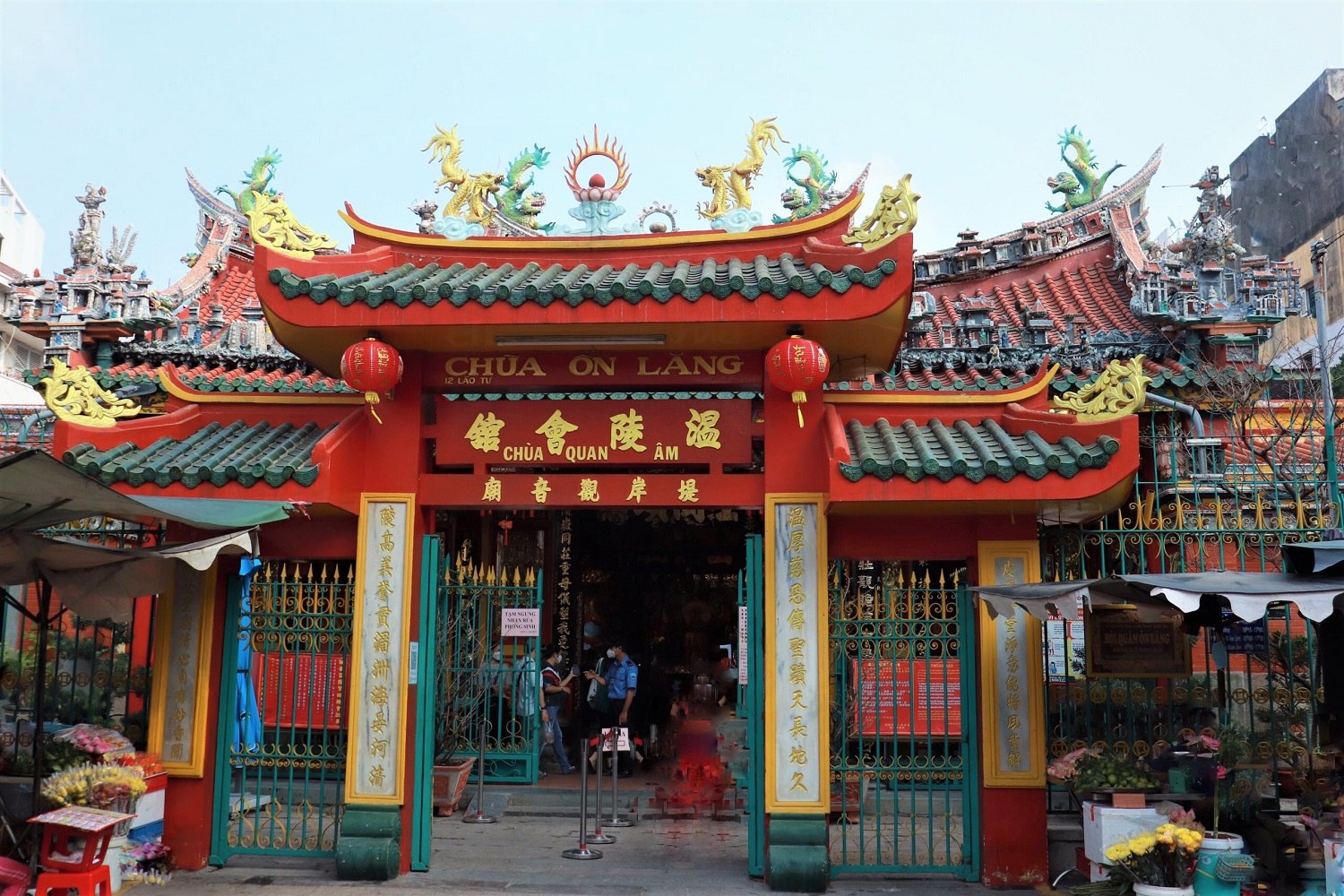
Quan Am Pagoda is one of the oldest and most beautiful Chinese pagodas in Ho Chi Minh City. The ancient pagoda is a religious site for locals and an attraction for tourists because of its unique architecture. It is a witness to Saigon’s history, with memories of the past carefully preserved beneath the ancient roofs.
1. Learn about the names and history of Quan Am Pagoda
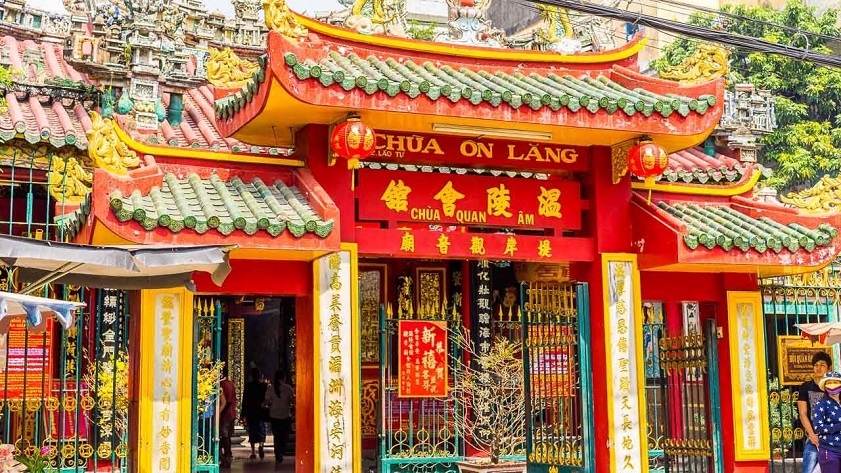
Quan Am Pagoda in Cho Lon Ward (Source: Collected)
Quan Am Pagoda is a stunning Buddhist temple from the 19th century. It is located in Cho Lon Ward (formerly District 5), and is dedicated to Quan Am, the Goddess of Mercy and Compassion. The temple complex is divided into three sections, each with an altar dedicated to Thien Hau (Mazu), Ngoc Hoang (the Jade Emperor), and Quan Am (Guanyin).
1.1 Location
- Address: No. 12 Lao Tu Street, Cho Lon Ward, Ho Chi Minh City
- Opening hours: 6:15 am – 5:00 pm daily
- Entrance fee: Free
1.2 History
According to some documents, the Quan Am Pagoda was established in 1740 by the Chinese people (mainly from Fujian) who migrated to Vietnam. This pagoda in Ho Chi Minh City began as a gathering place for Chinese people to help one another and meet their spiritual, religious, and cultural needs. So, it was first called the On Lang Assembly Hall. On Lang is a town in Xuanzhou, China. Only after they began to worship Quan Am here, it received the name Quan Am Pagoda.
It went through many restorations in 1828, 1867–1869, 1897, 1993, and 1995. On April 27, 2004, Quan Am Pagoda was recognized as a National Architectural Site.
1.3 Other names of Quan Am Pagoda
Quan Am Pagoda is not the only name that this attraction has. People refer to it by several names: On Lang Pagoda, On Lang Assembly Hall, and Ong Lao Pagoda. Among these names, On Lang Pagoda or On Lang Assembly Hall was the site’s first name and is also the one that locals are most familiar with.
2. What is Quan Am Pagoda Ho Chi Minh City famous for?
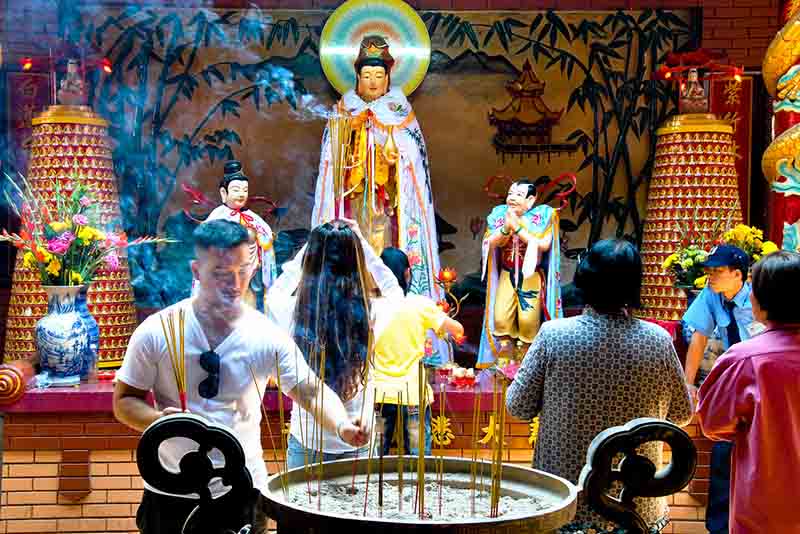
People pray and place their offerings at the altars in Quan Am Pagoda Ho Chi Minh City (Source: Collected)
Đánh kẻ tiểu nhân (or “Beat the villains”) is probably the most special ritual that takes place at the pagoda. People who come to worship repeatedly hit the paper dolls (the villains) with their shoes. It is believed that hitting the paper dolls prevents the evil spirits from harming others.
This custom takes place in front of the Tiger altar on Jingzhe, which is March 5 and 6 of the solar calendar. Tangerines and dumplings with red Chinese characters such as Phuoc (fortune) and Dai Phat (wealth) are the two most popular offerings, and they must be served in pairs or in an even number. A chunk of raw pork is set on the main side of the Tiger altar.
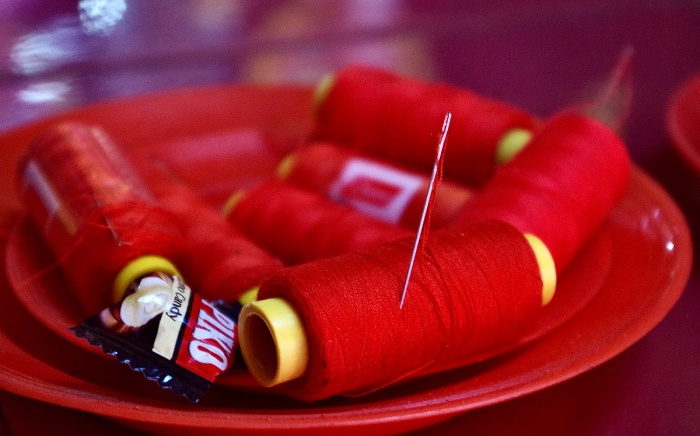
Offerings for the ceremony to pray for love at Quan Am Pagoda (Source: Collected)
In addition to the custom of “beating the villains”, Quan Am Pagoda is also known for its ceremony to pray for love. Visitors who come to pray for love need to buy red thread rolls, on top of which are pre-threaded needles, which are then placed at the altar of Hoa Phan Phu Nhan (the goddess of beauty and love).
Best-selling products
![[Grand Park] Adventure Express](http://booking-static.vinpearl.com/tours/eeb9a602315342ccbc7965b29cfb0db0_Ảnh%20màn%20hình%202025-03-03%20lúc%2015.00.17_vinwonders-nam-hoi-an-ve-vao-cua.png)
![[Grand Park] Water Park + Dream Garden Outdoor Games Combo](http://booking-static.vinpearl.com/tours/35566b714d4c4dd9802a6bf4650ac2b1_khu-vui-choi-cua-hoi-9_vinwonders-nam-hoi-an-ve-vao-cua.jpg)
3. Unique features of the architecture of Quan Am Pagoda
Although there are many impressive places to visit in Ho Chi Minh City, Quan Am Pagoda is still an attractive cultural site thanks to its unique architecture. The artists used special techniques to build the pagoda in the shape of a dragon boat, which is typical of the bold architecture of Fujian. Even from the outside, you can easily see that red and golden colors dominate the pagoda.
3.1. The roof
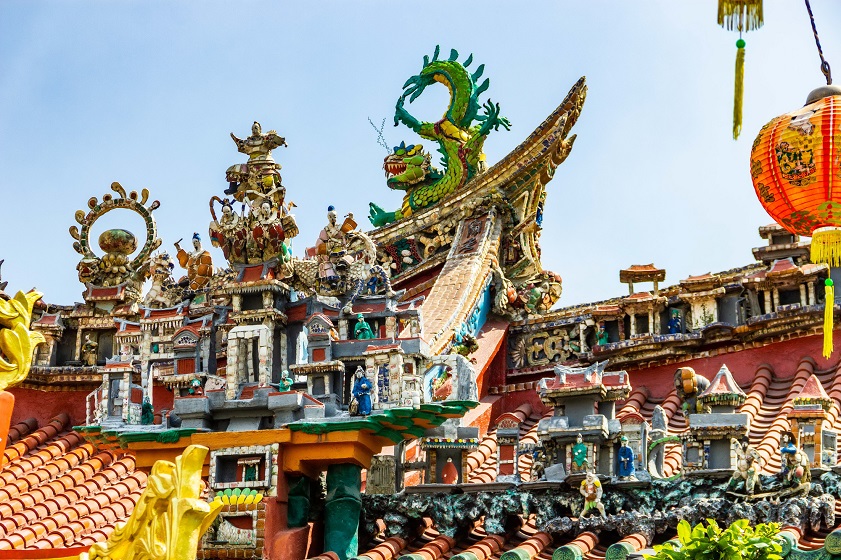
The details of Quan Am Pagoda’s roof (Source: Collected)
The Quan Am Pagoda’s roof is built in Fujian architectural style, with a tiled roof and a wooden frame. A statue of a deity or general holding a blade and riding a dragon-like animal stands atop the roof. The roof’s curved eaves were decorated with broken ceramic pieces.
3.2. The exterior
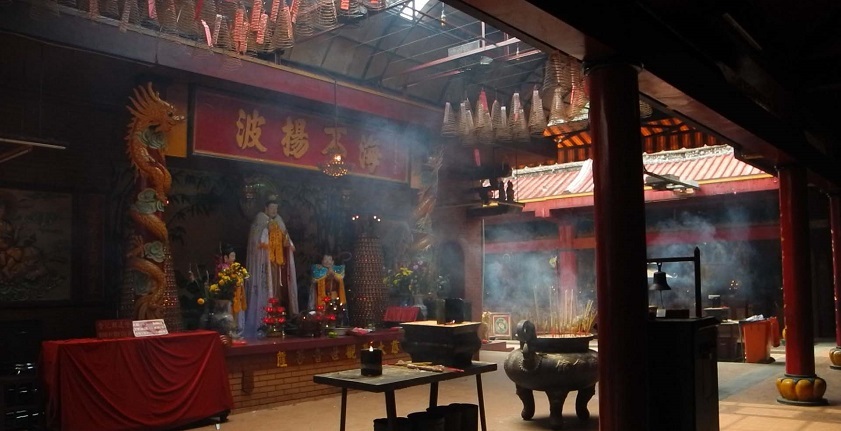
The Quan Am altar is the most crowded place in the pagoda (Source: Collected)
The Quan Am Pagoda has a total area of 1,800 square meters, and its architecture was inspired by ancient Chinese temples and pagodas. The entire complex features a central house with three main halls, surrounded by three buildings.
The buildings are arranged in rows that are perpendicular to one another and form a U shape around the central house. Two rows of vertical rows of blocks serve as both the worship space and the office, while the horizontal row serves as the back hall.
Outside the pagoda, on the opposite side of Lao Tu Street, there is a garden with an artificial pond for fish release.
3.3. The interior
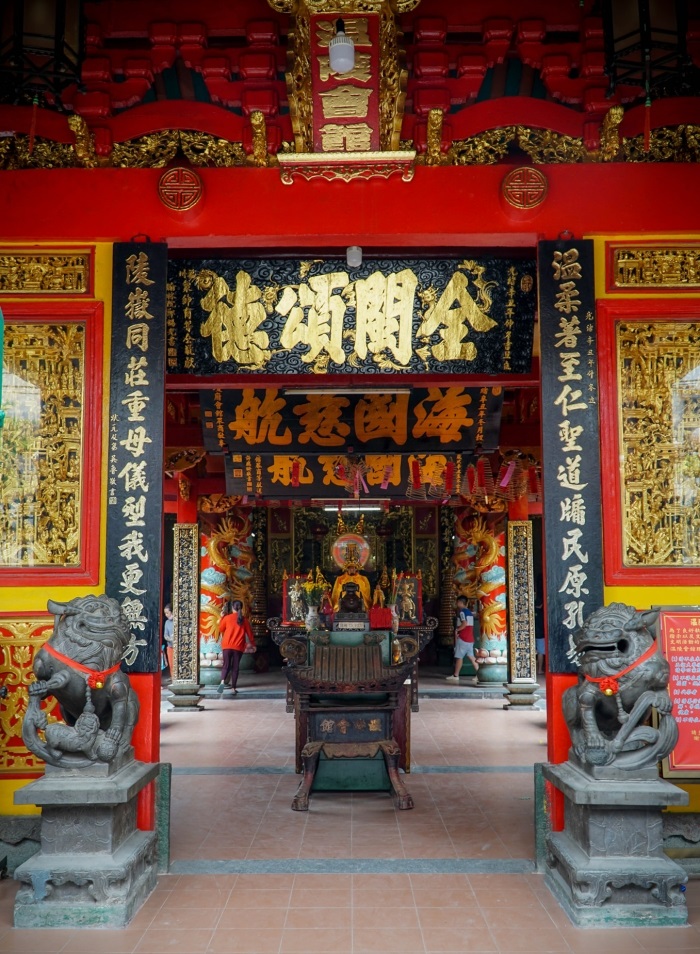
Wooden panels with golden Chinese characters in the main hall (Source: Collected)
Inside the Quan Am Pagoda is a one-of-a-kind combination of many art forms, from sculpture to decoration to painting. The assembly hall is filled with altars and statues. The worshipping statues here are colored and decorated similarly to those at Thien Hau Temple. The artists portrayed the saints’ personalities and charisma through facial expressions and figures.
Many beautiful ornaments can be found throughout the halls, such as the pink carved wood lotus and red lacquered golden gilt flower pots. Lanterns of various shapes adorn the pagoda, from the main entrance to the front of the halls.
Some of the wood panels and pillars in the Quan Am pagoda are richly carved, and the letters or drawings can be gilded to make them look beautiful. These delicate carvings include panels, parallel sentences, “bao lam”, dragon pillars, ornaments made from broken ceramic pieces, and ancient bells.
The pair of stone lions at the front hall’s door, dating from 1869, is one of the most striking sculptures here. The left lion is holding a pearl, while the right lion is playing with the lion cub.
4. How to get to Quan Am Pagoda in Ho Chi Minh City?
Quan Am Pagoda is hidden behind food stalls and marketplaces on Lao Tu Street in Cho Lon Ward. The pagoda is easily accessible by taxi, Grab or by using Google Maps if you have your own transport.
From Nguyen Hue pedestrian street, follow Nguyen Thi Minh Khai street through the roundabout, then turn onto Hung Vuong street and then Hong Bang. Then, turn left at the intersection of Chau Van Liem and then continue to turn left on Lao Tu Street to arrive.
Those arriving by bus should take bus numbers 6, 7, 8, 17, 54, 56, 62, 68, 139, or 150 to Cho Ray Hospital bus station, then walk a short distance to the pagoda.
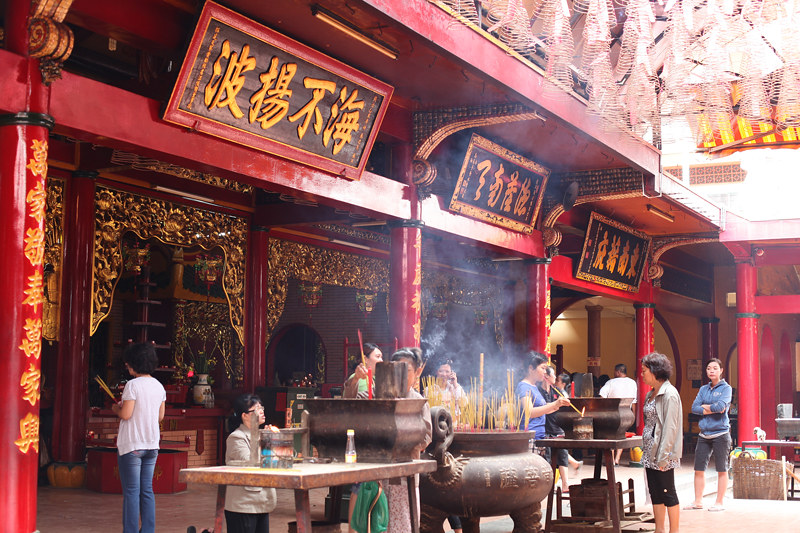
Tourists visit the inside of Quan Am Pagoda in Saigon (Source: Collected)
For those looking to extend their journey beyond Pagodas, Ho Chi Minh City offers a variety of entertainment options. Grand Park, located in Thu Duc City, is a fantastic destination for families and solo travelers alike. The immersive complex features the Tropical Island water park, where families splash and play. Towering illuminated trees transform the garden into an enchanted wonderland, while an urban beach offers a perfect escape. Special events bring unique magic to visitors, and diverse shops and restaurants complete this year-round entertainment destination.


There are many places to visit in Ho Chi Minh City, so tourists often spend several days here. Yet, aside from this modern city, you can head to destinations like Phu Quoc, Nha Trang, Hoi An, Da Nang, etc. When travelling to these incredible destinations, there are numerous sites to see and activities to enjoy.
When travelling to these destinations, you can choose your stay at one of the Luxurious Vinpearl hotels and resorts. The accommodations are designed to bring the best experience to guests, from fine restaurants and wide pools to healing spas and beautiful gardens.
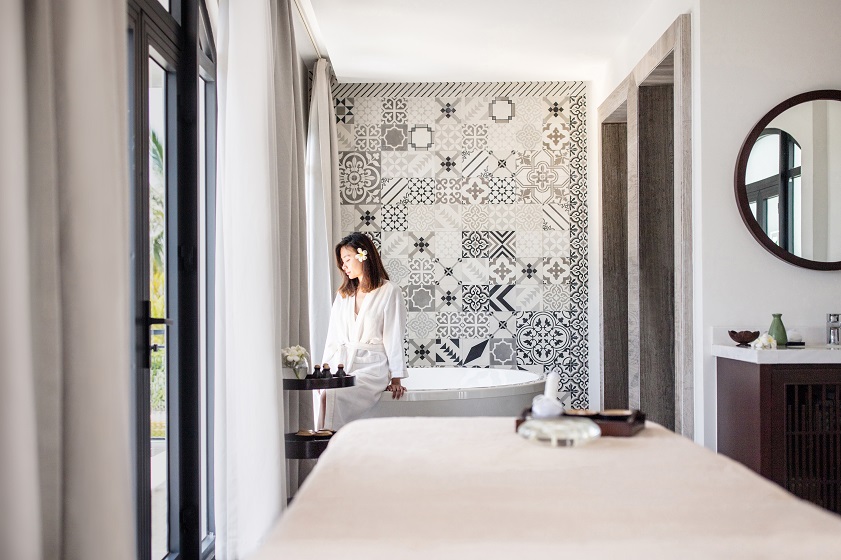
Enjoy a perfect stay at Vinpearl Nha Trang
Book rooms in Vinpearl Phu Quoc
Book rooms in Vinpearl Nha Trang
Book rooms in Vinpearl Resort & Golf Nam Hoi An
The Quan Am Pagoda is a cultural icon of Cho Lon Ward in Ho Chi Minh City. It is a must-visit if you are keen on learning more about the history and culture of the Chinese and Vietnamese communities in this area.




![[Mega Sale 2.2] Get up to 50% off VinWonders on Double Day](https://static.vinwonders.com/production/2025/12/homepage-banner-3-336x161.jpg)


