en
en


 Tiếng Việt
  中文 (中国)
  한국어
한국어  Русский


 04/12/2025
 2.041 views
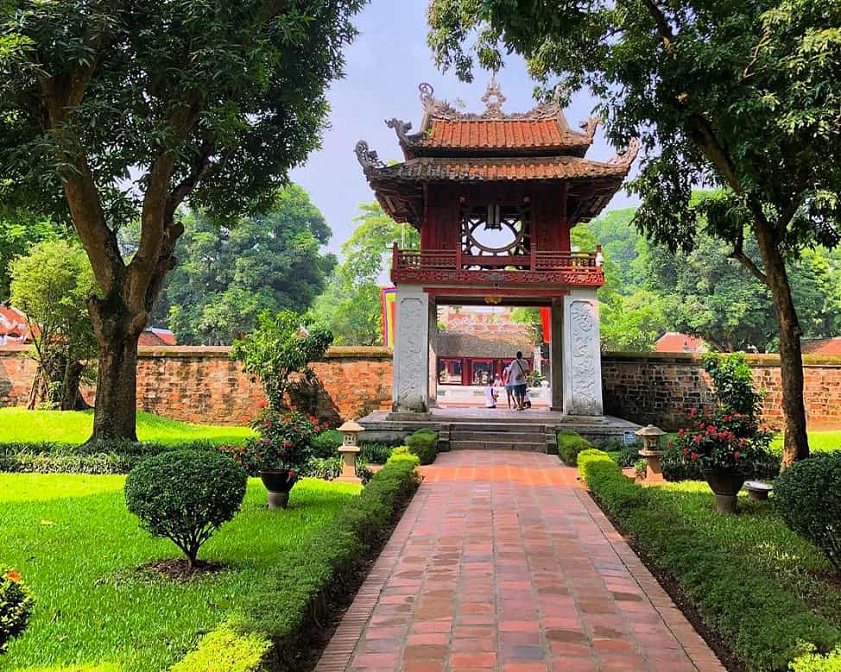
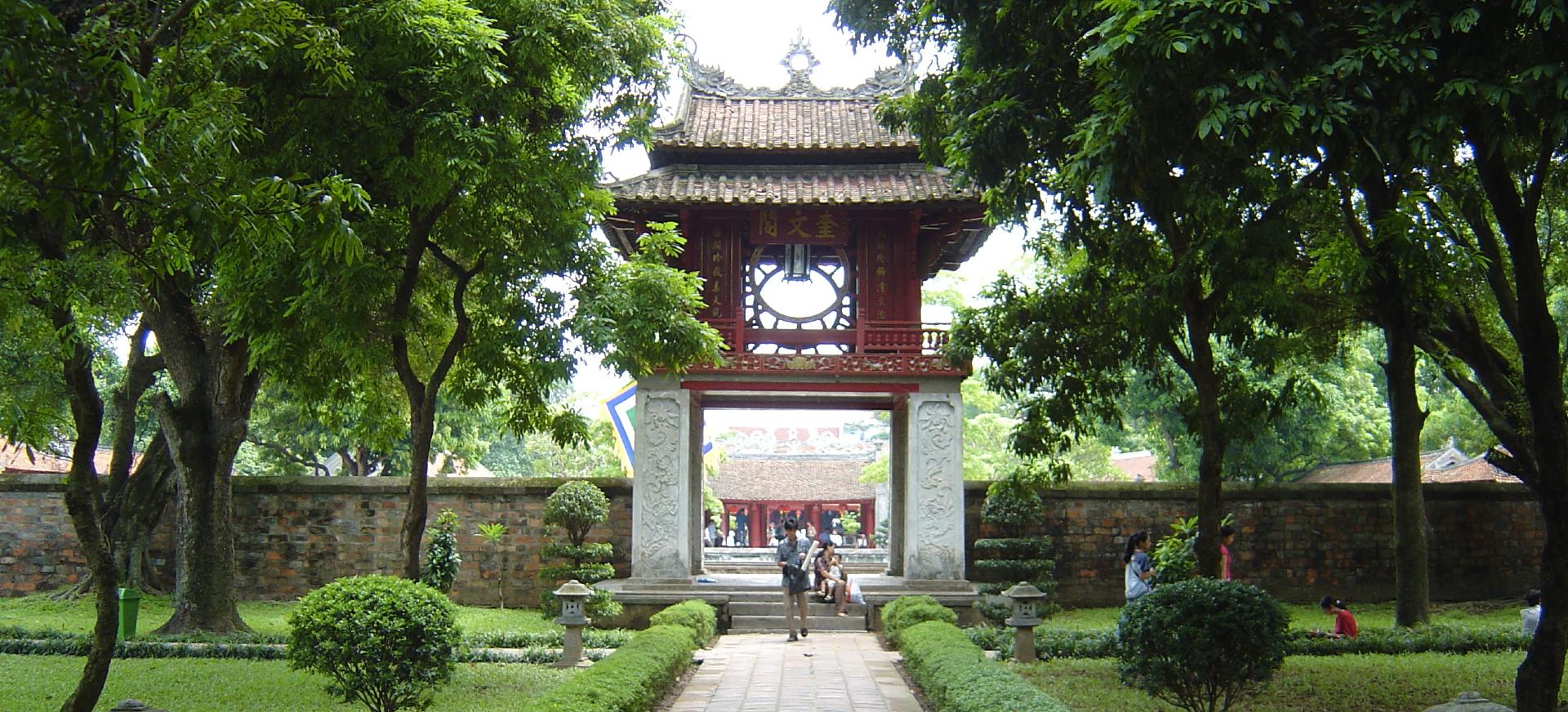
Khue Van Cac is a symbol of Hanoi, representing Vietnam’s tradition of valuing education (Source: Collected)
1. What is the Hanoi symbol?
Khue Van Cac, located at the Temple of Literature, is the Hanoi symbol. Esteemed by both Vietnamese people and international visitors, it embodies the city’s rich history and cultural heritage.
As part of the Temple of Literature complex – Vietnam’s first university, Khue Van Cac reflects the nation’s deep-rooted tradition of valuing education. This symbol not only highlights Vietnam’s long-standing cultural heritage but also captures the aesthetics and solemnity that represent Hanoi.
Hanoi attractions: Unveil 18 MOST captivating destinations to visit
What is Hanoi famous for? TOP 5 things that put the capital on the map
Hanoi itinerary: Top attractions, fun activities and delicious food
2. Things to learn about the meaningful Hanoi symbol
2.1. The time-honored history
Khue Van Cac was built in 1805 during the reign of King Gia Long of the Nguyen dynasty. It is part of the Temple of Literature (built in 1070), which has educated thousands of talented individuals for the country.
For over 200 years, Khue Van Cac has stood as a historical witness to Vietnam’s tradition of valuing education, with numerous steles honoring scholars. It has seen the country’s historical ups and downs, the evolution of Vietnamese literature, and the efforts to honor and preserve the long-standing cultural values of Hanoi and Vietnam.
2.2. The impressive architecture
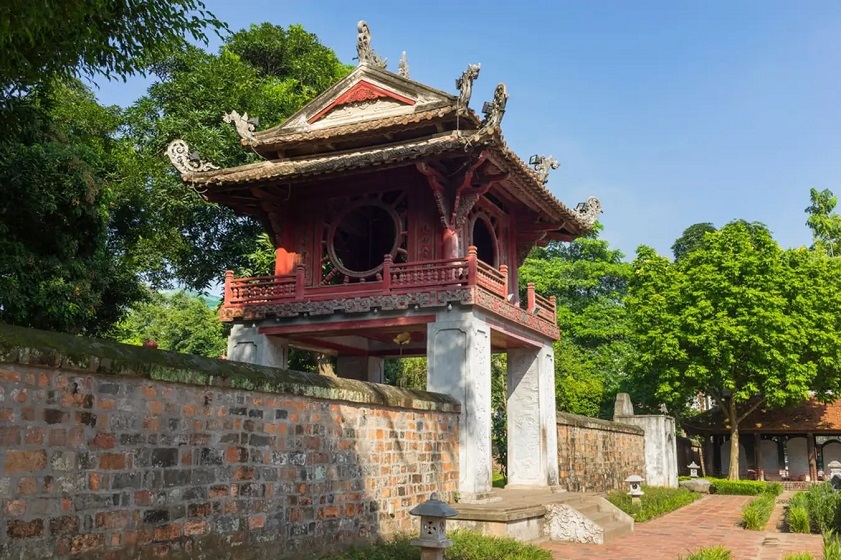
The impressive architecture of Khue Van Cac (Source: Collected)
The symbol of Hanoi – Vietnam, Khue Van Cac, also impresses with its remarkable architecture. It features a square pavilion with eight ancient-tiled roofs, supported by four large square pillars adorned with intricate details. The structure is built of wood with meticulously carved decorative patterns.
Each of its four sides has a round window with wooden bars radiating outward, symbolizing the rays of the Khue star. The pavilion houses a gilded red board with the three Chinese characters “Khue Van Cac” and couplets praising enduring academic pursuits.
2.3. The symbolic significance
What is the symbol of Hanoi’s meaning? Khue Van Cac – Hanoi symbol, carries profound symbolic significance, closely associated with Confucian values and Vietnamese culture. Historically, scholars have regarded the Khue star as the brightest among the 28 constellations, symbolizing success and literature. Therefore, Khue Van Cac represents the pinnacle of wisdom, echoing the truth that “Talented individuals are the nation’s vitality” inscribed on the steles at the Temple of Literature.
The round windows of Khue Van Cac are also seen as gathering all the essence of heaven and earth, symbolizing human aspirations for learning and development. With its deep philosophies and values, honoring the Vietnamese tradition of valuing education, Khue Van Cac is considered a symbol of Vietnam’s cultural heritage.
Hanoi things to do: TOP activities to put on your bucket list right away
Hanoi free local tours: The BEST choices for authentic adventures
Hanoi 36 streets: Discover traces of the once bustling commercial area
Best-selling products
![[-60%] [VinWonders Hanoi Water Park] Direct admission ticket](http://booking-static.vinpearl.com/tours/f949b31af919495c9b4e111237642763_358600999_111579731994757_433244877993048710_n_vinwonders-ha-noi.jpg)
![[Deep Relaxation Combo] [Female] – Jjimjilbang Sauna & Korean Sesin Body Scrub](http://booking-static.vinpearl.com/tours/0be276c684454e8d969c373f35f6be97_DSC_2127_11zon_aquafield-nha-trang.jpg)
![[Aquafield Ocean City] - Body Exfoliation Session](http://booking-static.vinpearl.com/tours/0e8ee4024e1f4378ba932eb06d945636_Screenshot_14_aquafield-nha-trang.png)
![[Aquafield Ocean City] [Female] – Standard Jjimjilbang Sauna Ticket](http://booking-static.vinpearl.com/tours/4aec5fed6be54fe8a736aca12893384b_40fc72547fe242f8b6bbbbc428885848_065A8735_aquafield-nha-trang_aquafield-nha-trang.jpg)
![[Times City] Combo VinKE & Vinpearl Aquarium Entrance Ticket](http://booking-static.vinpearl.com/tours/d6296ca1d3714503b01f24603b85b8cf_vinke1_vinke-ve-vao-cua-truc-tiep.jpg)
![[Aquafield] - [Male] - 4-hour Korean Sauna](http://booking-static.vinpearl.com/tours/94abeb55e3d54efbac23f7a862445389_0d72b531dd6749bbac2874b915ab0512_Screenshot_8_aquafield-nha-trang_aquafield-nha-trang.png)

![[-10%] [Times City Hanoi] - Combo Aquarium Admission Ticket + F&B Set](http://booking-static.vinpearl.com/tours/e7fcffc8256546e8bdcfd5ccfbe69783_VINKE2%20(1)_vinke-ve-vao-cua-truc-tiep.jpg)
![[Grand World] Carousel Ride](http://booking-static.vinpearl.com/tours/0d6a4bcfc2a54fd4aa9df0b38ae8c7b6_A2-4-jpeg-2640-1687438608_grandworld.jpg)
![[Aquafield Ocean City] [Male] – VIP Membership (12 Months)](http://booking-static.vinpearl.com/tours/6ab10678fcbd4822a8fddb0590d3bcbf_0d72b531dd6749bbac2874b915ab0512_Screenshot_8_aquafield-nha-trang_aquafield-nha-trang.png)
![[Body Pampering Combo] [Female] – Korean Jjimjilbang Sauna & Vincharm Spa Body Massage](http://booking-static.vinpearl.com/tours/70151cf03d8549d88b48b432f2082dda_Screenshot_2_aquafield-nha-trang.png)
![[Vinpearl Aquarium Times City] Entrance Ticket](http://booking-static.vinpearl.com/tours/8702a10bf2934d6299df65669a290679_aquarium%20times%20city%203_thuy-cung-vinpearl-aquarium-times-city.jpg)
![[Aquafield Ocean City] – VIP Membership (12 Months)](http://booking-static.vinpearl.com/tours/3c2f7ab0ed374cb1bbdb2e54e6d6eb9a_e1f2756dfec346f3bb3b16e296b3b166_Screenshot_5_aquafield-nha-trang_aquafield-nha-trang.png)
3. Other Hanoi symbolic landmarks to explore on your trip
Alongside Khue Van Cac, Hanoi boasts many iconic landmarks deeply rooted in its history, culture, and local life, essential for travelers exploring the thousand-year-old capital.
3.1. One Pillar Pagoda

One Pillar Pagoda is a must-visit destination in Hanoi (Source: Collected)
A prominent symbol of Hanoi, Vietnam is One Pillar Pagoda, constructed in 1049, featuring the distinctive image of a lotus rising from the water. This ancient pagoda stands as one of Asia’s most unique architectural marvels. Visitors to One Pillar Pagoda can admire not only its unique architecture but also immerse themselves in its humanistic values, symbolizing vitality and longevity, lighting incense, and praying for intellectual fulfillment and inner peace.
3.2. Hoan Kiem Lake – A Hanoi symbol
Hoan Kiem Lake is the heart of Hanoi, occupying a strategic position with profound historical significance and close ties to local life. Visitors should take time to stroll around the lake, enjoy its serene natural scenery, visit Turtle Tower, and experience its peaceful atmosphere while learning about the lives of residents. On weekends, Hoan Kiem Lake walking street becomes an ideal spot for cultural and artistic activities, and vibrant entertainment, particularly appealing to the younger generation.
3.3. The Huc Bridge
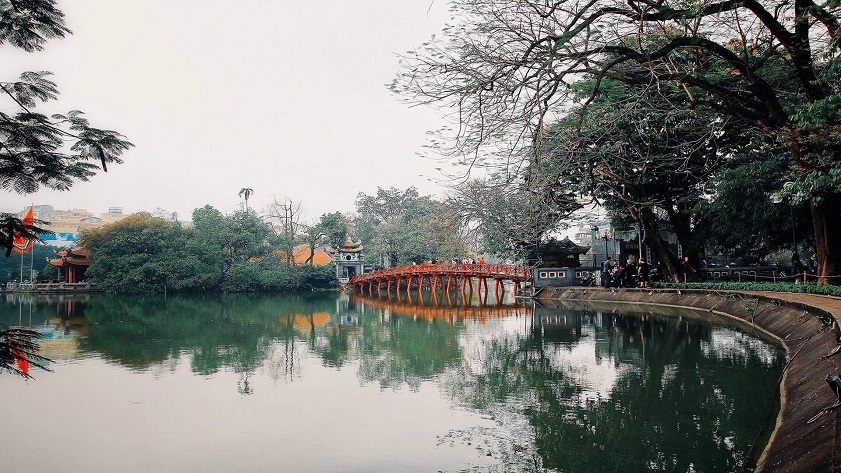
The graceful Huc Bridge stands out in Hoan Kiem Lake (Source: Collected)
Prominent on the tranquil waters of Hoan Kiem Lake is the graceful The Huc Bridge, a charming symbol of Hanoi. Built in 1865 using red-lacquered wood, its curved design symbolizes ‘Where the Sun’s rays first touch in the early morning.’ When visiting Hoan Kiem Lake, do not miss the opportunity to admire and capture photos with The Huc Bridge, along with a series of historical relics nearby like Pen Tower, Ink Slab, and Ngoc Son Temple.
3.4. Ho Chi Minh Mausoleum
Ho Chi Minh Mausoleum, housing President Ho Chi Minh’s remains, is a must-visit Hanoi symbol. Built on the historic Ba Dinh Square, this architectural masterpiece embodies the heartfelt reverence of the entire nation and international friends toward President Ho Chi Minh. Besides paying respects, visitors can stroll through the serene, solemn atmosphere and admire its impressive architecture.
Ba Dinh Square: A place marking the history of the Vietnamese nation
Ho Chi Minh’s Stilt House: An outstanding heritage in the heart of Hanoi
Presidential Palace Hanoi: Explore a special national relic of Vietnam
3.5. Hanoi Flag Tower
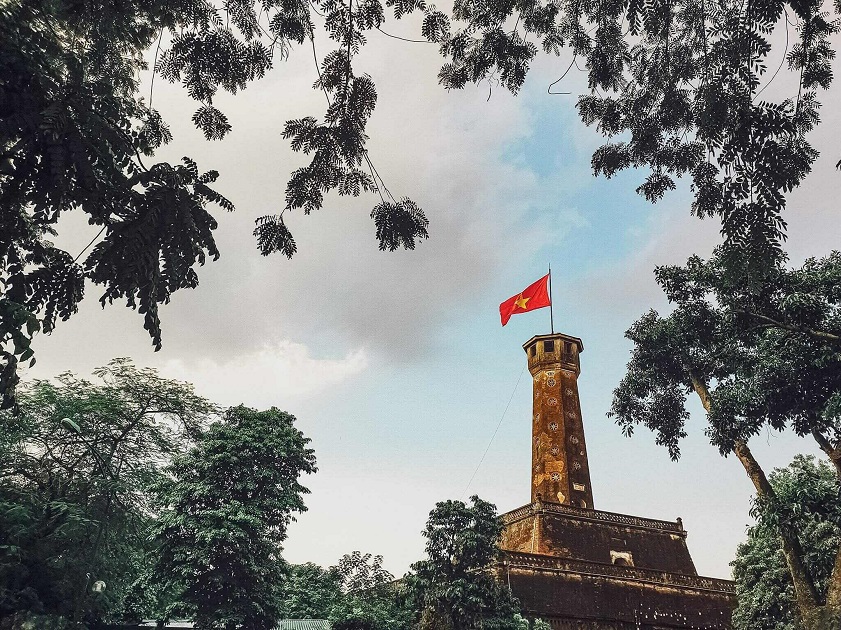
Feel the pride of the Vietnamese nation when visiting the Hanoi Flag Tower (Source: Collected)
Hanoi Flag Tower, with a history of over 200 years, stands as a symbol of Hanoi with its grand architecture and historical significance. Notably, the red flag with a yellow star flying here during the August Revolution Day in 1945 marked Vietnam’s independence. It has been, and will always be, a symbol of glory and pride for the nation.
3.6. Long Bien Bridge
Long Bien Bridge, the first steel bridge spanning the Red River, constructed by the French from 1899 to 1902, stands as a Hanoi symbol. Here, visitors have the opportunity to admire the picturesque scenery of the Red River, leisurely walk or cycle across the bridge, witness firsthand the rusty steel frames, and see the scars left by American bombing to understand its ancient historical stories.
3.7. Tran Quoc Pagoda

Tran Quoc Pagoda is one of the oldest and most sacred pagodas in Vietnam (Source: Collected)
One of Hanoi’s iconic symbols is Tran Quoc Pagoda, one of Vietnam’s oldest pagodas, built during the reign of King Ly Nam De (544 – 548). Situated on a small island in West Lake, it offers a romantic and tranquil space with its intricate architecture. Once the center of Buddhism in the ancient Hanoi, the pagoda holds significant historical values, serving as a sacred Buddhist gateway for visitors seeking inner peace and learning about Buddhism.
Quan Su Pagoda: A must-visit spiritual site in Hanoi
Quan Thanh Temple: An ideal place to experience spiritual tourism in Hanoi
Bach Ma Temple: Explore an important cultural relic of Hanoi Capital
3.8. Hanoi Opera House
Hanoi Opera House is a historically and architecturally significant structure in the cultural life of residents. It was built by the French colonialists from 1901 to 1911 in a European neoclassical style. Its prominent yellow facade makes it an irresistible check-in spot for tourists. Today, it continues to host major artistic programs, where visitors can experience and appreciate Vietnam’s cultural and artistic values.
3.9. Imperial Citadel of Thang Long
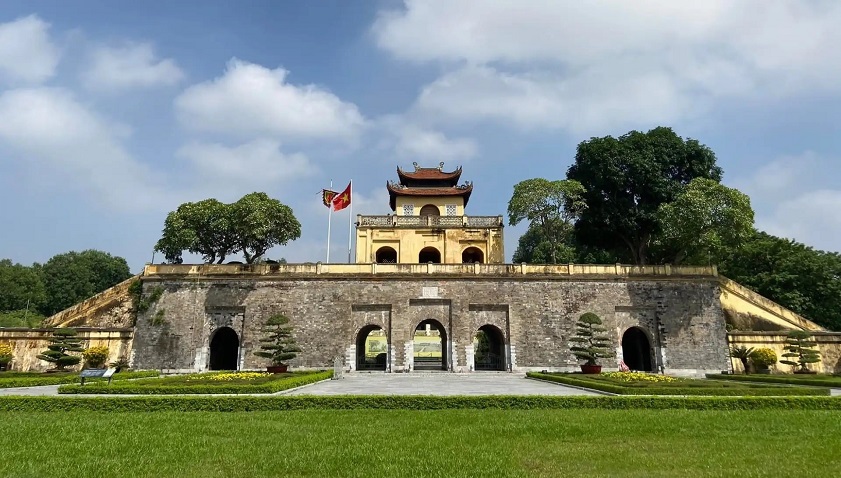
Learn about the rich 1,000-year history of Hanoi at the Imperial Citadel of Thang Long (Source: Collected)
Imperial Citadel of Thang Long is another unique symbol of Hanoi, considered a ‘living history book’ spanning over 10 centuries of Thang Long – Hanoi. This historical complex comprises multiple points of interest with layers of architectural relics and artifacts such as ceramics and coins from various historical periods, offering visitors deeper insights into the city’s development and historical ups and downs.
Hanoi train street: Reminisce the splendid past of a unique place
Phung Hung Mural Street: Where the memories of old Hanoi are kept
Vietnam National Museum of History: A worthy place for your trip in Hanoi
Exploring the Hanoi symbol reveals the city’s deep historical and cultural roots. From the scholarly Khue Van Cac to the serene Hoan Kiem Lake, each landmark tells a unique story. Do not miss a chance to immerse yourself in Hanoi’s rich heritage and experience the pride and beauty of Vietnam’s capital.
After exploring the cultural and historical Hanoi symbols, do not forget to relax and have fun at Ocean City in the east of the city. Ocean City offers fantastic entertainment options such as VinWonders Wave Park & Water Park, a state-of-the-art water park with numerous wave pools, thrilling water slides, and beach sports. Additionally, there is Grand World, a vibrant entertainment hub with endless shopping, dining experiences, and stunning architecture.
To enjoy a comfortable and well-equipped stay at a reasonable price within this complex, consider StaynFun, the first homestay brand managed by Vinpearl. StaynFun offers a perfect blend of modern amenities and cozy, home-like accommodations.

Don’t miss to engage in various beach sports at VinWonders Wave Park & Water Park